The Future of Full Stack Development in the AI Era
What the full stack engineering role actually looks like as AI absorbs more implementation work — and which skills become more valuable, not less, as a result.
NavikaTech
Updated May 14, 2026
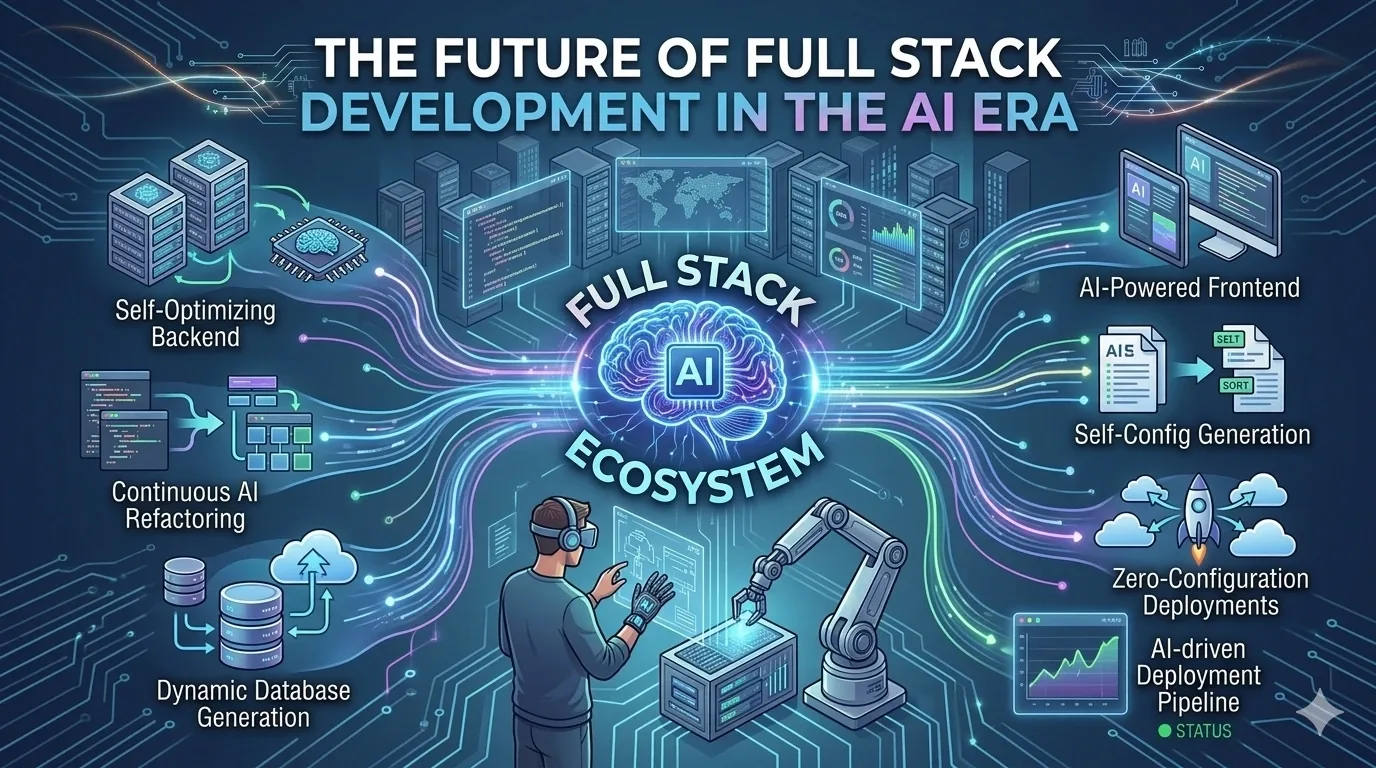
Every generation of developer tooling triggers the same anxious question: does this make engineers obsolete? Compilers didn't end programming, high-level languages didn't end systems engineering, and frameworks didn't end frontend development — each shift moved the work up a level of abstraction and raised the bar on judgment rather than eliminating the role. AI-assisted development looks like the same pattern, at a faster pace.
Implementation is becoming commoditized
Writing a CRUD endpoint, a form with validation, or a standard authentication flow is increasingly something AI tooling can produce a solid first draft of in seconds. That's not a controversial claim anymore — it's observably true in most modern IDEs. What that means for full stack engineers is that the differentiated value shifts away from 'can you write this code' and toward 'do you know what code should exist, and can you verify what got written is correct.'
Full stack breadth becomes a genuine advantage
AI tools are strongest within a well-scoped file or function and weakest at reasoning about how a change ripples across an entire system — a database migration's effect on an API contract, an API contract's effect on three different frontend consumers. Engineers who hold that whole picture in their head — the traditional full stack skill set — are positioned to catch exactly the class of mistake AI tooling is most likely to make.
| Skill | Becoming less scarce | Becoming more scarce |
|---|---|---|
| Writing boilerplate CRUD code | ✓ | |
| Reviewing a diff for correctness under real business rules | ✓ | |
| Translating ambiguous product requirements into a spec | ✓ | |
| Debugging an unfamiliar framework's API from docs | ✓ | |
| Reasoning about cross-service failure modes | ✓ |
Specification-writing becomes a core engineering skill
The quality of AI-generated code is bounded by the quality of the specification it's given. Engineers who can turn a vague product ask into a precise, testable spec — edge cases enumerated, error states defined, acceptance criteria written down — get dramatically better results from AI tooling than engineers who prompt with the same ambiguity they'd historically carried into a solo implementation.
Being a good full stack engineer in this era looks a lot like being a good tech lead used to look — just applied to a much larger volume of code. — Ritwik Sharma, Founder & CTO, NavikaTech
What this means practically, today
- Invest in the parts of the stack that are hardest to fully specify — data modeling, API contracts, failure handling — over memorizing syntax.
- Get deliberately good at reviewing code fast and correctly; it's becoming as central a skill as writing it.
- Practice writing specs and acceptance criteria as a discrete skill, not an afterthought before 'real work' starts.
- Stay close to the full request lifecycle — database to API to UI — rather than specializing narrowly in one layer.
Conclusion
Full stack development isn't disappearing in the AI era — the center of gravity is moving from typing code to specifying, reviewing, and reasoning about systems as a whole. That's a harder, more senior skill set than the one it's replacing, and engineers who build it deliberately will find themselves more valuable, not less, as these tools keep improving.
Key Takeaways
- Implementation speed is becoming commoditized; system-level thinking and judgment are becoming the scarce skill.
- Full stack engineers who understand the whole system — not just syntax across layers — are best positioned for an AI-assisted workflow.
- Communication and specification-writing become core engineering skills, not adjacent ones, as AI does more of the typing.
- The role doesn't shrink — it moves up a level of abstraction, similar to how compilers changed what 'programming' meant.
Recommended Resources
NavikaTech
NavikaTech shares practical engineering notes on web development, app development, custom software, automation, AI, and long-term software maintenance.
Related Articles

Stay Updated With Modern Software Engineering
One email, occasionally — practical engineering writing from the NavikaTech team, no noise.