Building Scalable REST APIs with Node.js and Express
Learn how to design maintainable, scalable REST APIs using Express.js, proper project architecture, validation, authentication, error handling, caching, and database optimization.
NavikaTech
Updated April 8, 2026
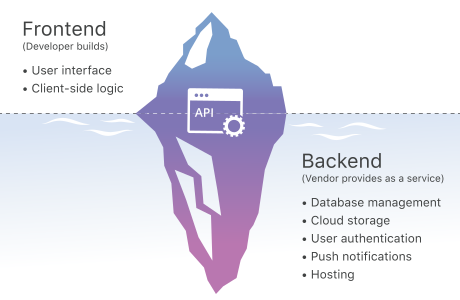
Every backend eventually reaches a point where adding one more endpoint feels riskier than it should. Usually the framework isn't the problem—it's the architecture. Express remains one of the best backend frameworks because it stays out of your way, allowing you to design clean, maintainable APIs that scale with your application instead of fighting against it.
Build features, not route files
One of the biggest mistakes in Express applications is allowing business logic to leak directly into route handlers. Routes should only receive requests, validate input, invoke the appropriate service, and return a response. Everything else belongs elsewhere.
src/
├── controllers/
├── services/
├── repositories/
├── middlewares/
├── routes/
├── validators/
├── utils/
├── config/
└── app.ts
Keeping each layer focused makes testing significantly easier and allows your application to grow without becoming tightly coupled.
Validate every request
Never trust incoming data.
Every request entering your application should be validated before reaching your business logic.
import { z } from "zod";

export const createUserSchema = z.object({
  name: z.string().min(3),
  email: z.string().email(),
  age: z.number().min(18)
});
Validation libraries such as Zod or Joi immediately reject malformed requests and eliminate dozens of unnecessary defensive checks deeper in the application.
Centralize error handling
Duplicating try/catch blocks in every controller creates noisy code.
Instead, throw meaningful application errors and let a centralized middleware convert them into HTTP responses.
export function errorHandler(err, req, res, next) {
    console.error(err);

    return res.status(err.status || 500).json({
        success: false,
        message: err.message
    });
}
This keeps controllers focused on business logic rather than response formatting.
Optimize database access
A slow API is almost always caused by slow database queries—not Express.
Use pagination, proper indexing, selective queries, and eager loading only when necessary.
const users = await User.findAll({
    limit: 20,
    offset: page * 20,
    attributes: ["id", "name", "email"],
    order: [["createdAt", "DESC"]]
});
Avoid loading entire records when only a few fields are required.
| Practice | Why it matters | Common mistake |
|---|---|---|
| Pagination | Prevents loading thousands of records | Returning every row |
| Validation | Stops invalid requests early | Validating inside services |
| Repository Layer | Separates database logic | Querying directly in controllers |
| Middleware | Reusable authentication and logging | Copy-pasting logic everywhere |
| Caching | Reduces repeated database queries | Caching frequently changing data |
A scalable API isn't the one with the fewest milliseconds of latency—it's the one another engineer can safely modify six months later. — Arjun Mehta, Principal Software Engineer, NavikaTech
Cache expensive operations
Some endpoints repeatedly execute identical queries.
Instead of hitting the database every time, cache frequently accessed data.
const cached = await redis.get(cacheKey);

if (cached) {
    return JSON.parse(cached);
}

const users = await repository.getUsers();

await redis.set(cacheKey, JSON.stringify(users), {
    EX: 300
});

return users;
Caching should target expensive read operations rather than every endpoint indiscriminately.
Secure your API
Security shouldn't be added after deployment.
Basic protections include:
- Helmet for secure HTTP headers
- Rate limiting
- JWT authentication
- Password hashing with bcrypt
- Input validation
- SQL injection prevention through parameterized queries
- Proper CORS configuration
These practices eliminate many common vulnerabilities before they become production incidents.
Conclusion
Express remains one of the most productive backend frameworks because it imposes very few architectural decisions. That flexibility is both its greatest strength and its greatest risk. By separating concerns, validating requests early, centralizing error handling, optimizing database access, and applying sensible security practices, you build APIs that remain easy to extend long after the first version ships.
Key Takeaways
- Keep your API architecture modular from day one using controllers, services, repositories, and middleware.
- Validation belongs at the API boundary—not inside business logic.
- Consistent error handling improves debugging and client experience.
- Database optimization and caching matter far more than micro-optimizing Express itself.
Recommended Resources
NavikaTech
NavikaTech shares practical engineering notes on web development, app development, custom software, automation, AI, and long-term software maintenance.
Related Articles

Stay Updated With Modern Software Engineering
One email, occasionally — practical engineering writing from the NavikaTech team, no noise.