How AI Is Transforming Modern Software Development
From autocomplete to autonomous agents — a practical look at how AI is reshaping the day-to-day work of building software, and what engineering teams should actually change because of it.
NavikaTech
Updated March 18, 2026
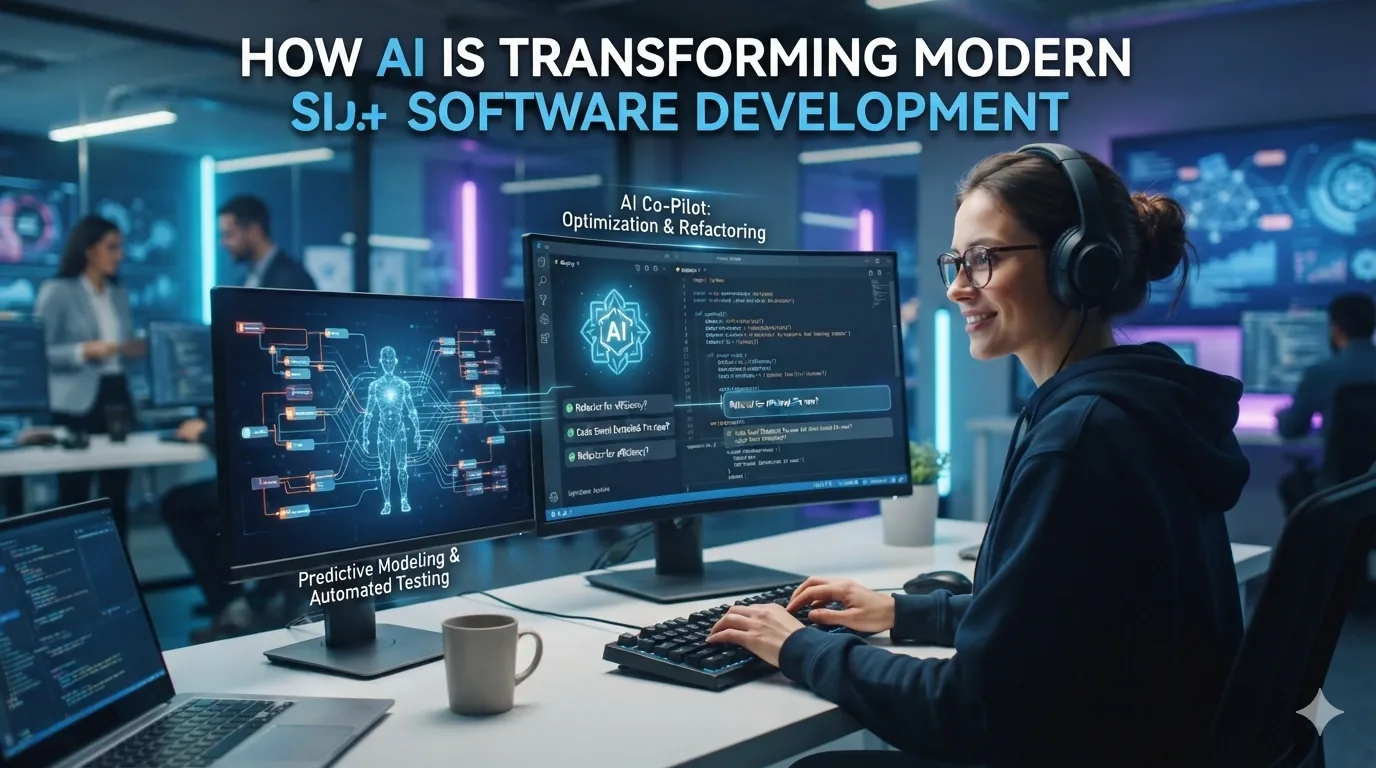
Three years ago, AI in software development meant autocomplete that occasionally finished your for-loop correctly. Today it means an agent that can read an issue tracker, open a pull request, write the tests, and explain its own reasoning. The gap between those two things is not a matter of degree — it's a different category of tool, and most engineering teams still treat it like the first one.
At NavikaTech we've spent the last year integrating AI tooling across client projects ranging from greenfield SaaS builds to decade-old monoliths. This article is less about the hype cycle and more about what actually changed in our day-to-day engineering process — and where AI still falls flat.
Two categories, not one tool
It helps to separate AI-assisted development into two distinct categories, because they solve different problems and fail in different ways.
| Category | What it does | Where it shines | Where it struggles |
|---|---|---|---|
| In-editor completion | Predicts the next few lines as you type | Boilerplate, repetitive patterns, test scaffolding | Novel algorithms, unfamiliar domain logic |
| Agentic coding | Plans, edits multiple files, runs commands, iterates | Well-scoped features, refactors, bug fixes with a clear repro | Ambiguous requirements, cross-team architectural tradeoffs |
The bottleneck moved from typing to judgment
The most consistent thing we've observed is that AI doesn't remove engineering work — it relocates it. Writing a CRUD endpoint used to take twenty minutes of typing. Now it takes two minutes of prompting and eight minutes of reading the generated code carefully enough to trust it. Net time saved, but the nature of the work shifted from production to verification.
This has a real implication for how teams should staff and structure work: engineers who are strong reviewers — who can spot a subtly wrong SQL join or a race condition in generated async code — become disproportionately more valuable, because their judgment is now the limiting factor on how much AI-generated code can safely ship.
// Example: AI-generated endpoint that looks correct at a glance
// but has a subtle race condition under concurrent requests.

export async function reserveInventory(orderId: string, sku: string, qty: number) {
  const item = await db.inventory.findUnique({ where: { sku } });

  if (!item || item.available < qty) {
    throw new Error("Insufficient inventory");
  }

  // BUG: read-then-write without a transaction or optimistic lock —
  // two concurrent requests can both pass the check above.
  await db.inventory.update({
    where: { sku },
    data: { available: item.available - qty },
  });

  return db.order.update({
    where: { id: orderId },
    data: { status: "reserved" },
  });
}Where it actually helps, concretely
- Test scaffolding — generating the first draft of unit tests against existing code, which a human then tightens.
- Migration and refactor mechanics — renaming APIs across a codebase, updating call sites after a signature change.
- First-pass documentation — README updates, JSDoc, changelogs generated from an actual diff rather than written from memory.
- Debugging with a repro — pointing an agent at a failing test and a stack trace narrows investigation time significantly.
- Boilerplate for well-known patterns — REST handlers, form validation, Dockerfiles, CI config.
Where it still struggles
Architectural decisions that require weighing organizational context — team size, deployment constraints, an existing vendor relationship — are still squarely human work. AI can lay out tradeoffs competently, but it has no stake in the decision and no memory of the three times your team tried a similar approach and it broke on-call for a week.
The tools got better at writing code. They did not get better at knowing what code should exist. — Ritwik Sharma, Founder & CTO, NavikaTech
A practical adoption path for teams
<Diagram caption="A staged rollout that keeps humans accountable for what ships" nodes={[ "Stage 1 — Completion tools in every editor", "Stage 2 — Agentic tools on tests + docs only", "Stage 3 — Agentic tools on scoped features, human-reviewed", "Stage 4 — Agents open PRs directly, gated by CI + review", ]} />
Teams that adopt AI tooling successfully tend to move through these stages deliberately rather than all at once. Skipping straight to 'agents open PRs directly' without first building review discipline around AI-generated code tends to produce a spike in subtly broken merges within the first month.
Conclusion
AI hasn't replaced the judgment, taste, and accountability that senior engineering requires — it has made the volume of code any single engineer is responsible for reviewing much larger. The teams getting real value are the ones who invested in review process and testing discipline first, then layered AI on top, rather than treating AI as a substitute for either.
Key Takeaways
- AI tools shift engineering time from typing code to reviewing and specifying it — the bottleneck moves to judgment, not output.
- Autocomplete-style AI and agentic AI solve different problems; teams should adopt them separately and deliberately.
- Code review discipline matters more, not less, in an AI-assisted workflow — treat AI output like a fast, confident junior engineer's PR.
- The biggest wins come from applying AI to well-scoped, well-tested parts of the codebase, not open-ended architecture decisions.
Recommended Resources
NavikaTech
NavikaTech shares practical engineering notes on web development, app development, custom software, automation, AI, and long-term software maintenance.
Related Articles

Stay Updated With Modern Software Engineering
One email, occasionally — practical engineering writing from the NavikaTech team, no noise.